

An increasing number of Chinese families are enrolling their children in extracurricular robotics and artificial intelligence programmes, believing that literacy in these technologies is essential for the next generation.
Many parents are also urging New Zealand’s education system to formally introduce these subjects into the national curriculum, arguing that early exposure is critical for preparing students for a rapidly evolving, technology-driven workforce.
Pauline Cleaver, acting deputy secretary of Te Poutāhū Curriculum Centre at the Ministry of Education, said the government’s 2025 budget includes targeted investment in science, technology, engineering and mathematics (STEM) education.
The Creative Imagination Laboratory (CILab), a robotics and programming institute in Auckland, has seen a sharp rise in enrolments among Asian students since the beginning of the COVID-19 pandemic.
“When we founded the institute in 2016, we had only around a dozen students,” said Hannah Nie, the institute’s director. “Today, we teach roughly 300.”
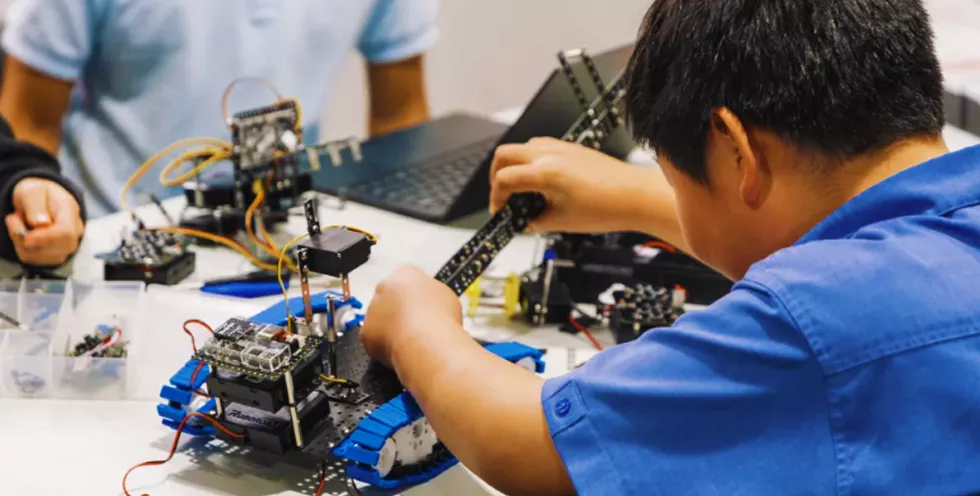
Young students learn technology, science and engineering through hands-on activities by building robots. Photo: RNZ / Yiting Lin
Nie said about 80 percent of CILab’s students are of Asian heritage, although interest from Middle Eastern, Russian and European families has been steadily increasing.
She also noted a shift in age groups, with younger children now more drawn to programming and robotics.
“Previously, intermediate and secondary school students made up about 80 percent of our enrolments,” she said. “But after COVID, we saw a surge in primary school students joining our programmes. They are now our largest group.”
Nie said the trend reflects a broader awareness among parents of the importance of early tech education.
“Many Asian families are beginning to realise that robotics and programming are essential skills their children will need to navigate the future,” she said.
James Wang, founder and instructor at iBot Academy NZ—an Auckland-based home robotics and programming school—has observed the same pattern.
A former software engineer and lecturer in the Faculty of Information Technology at Beijing University of Technology, Wang launched the academy with his wife in 2015.
He now offers three courses focused on robotics competitions, robot construction and the C programming language.
Wang said rapid advancements in artificial intelligence have fuelled rising demand for robotics education among Auckland’s Chinese families.
He urged New Zealand schools to increase investment in STEM education, saying it is crucial for preparing the next generation.
“I know some schools offer engineering classes,” he said. “But what they’re teaching is carpentry and ironwork. It’s outdated. It doesn’t meet the needs of modern society.
“Technological knowledge is incredibly important now—it’s foundational. With that base, students can learn other related subjects much more easily.”
Selina Chen, whose son attends Botany Downs Secondary College and takes robotics classes at CILab, agreed.
She said understanding technology and knowing how to work with robots will be critical for the next generation.
“In the future, robots and AI will be everywhere,” she said. “Even if children don’t become engineers, they still need to understand how these systems work and how to use them. It’s like how we all had to learn to use computers or smartphones.”
Chen also hopes to see more comprehensive robotics instruction introduced in schools.
“[My son’s school] has classes on AI and robotics—they call them technology classes,” she said. “But as far as I know, they don’t go very deep. It’s just basic.
“I’d like to see primary and secondary schools include robotics and AI as part of basic education. Technology is moving so fast, and it’s important for children to start understanding it as early as possible.”
Ling Zhao, whose eight-year-old son attends a robotics programme, said she hopes robotics and AI will eventually be integrated into the primary school curriculum, though she acknowledges that teaching resources are still limited.
“Resources are probably limited, especially because this is such a new area,” she said. “That’s why we chose to come here—to an after-school robotics programme.”
To promote greater engagement with robotics, AI and engineering, Ho Seok Ahn, a senior lecturer in the Faculty of Engineering and Design at the University of Auckland, has been leading national teams to represent New Zealand at the International Robot Olympiad since 2016.
Ahn said artificial intelligence is no longer confined to engineering, but is expanding rapidly into business, medicine, commerce and marketing—making it a critical field of knowledge for all generations, especially young people.
“It’s especially important for young people,” he said. “It’s closely tied to their future goals, including jobs and academic pathways.
“If they have no understanding or skills in AI, it will be much harder for them to find work in the future.”
Ahn agreed that New Zealand schools should invest more in integrating AI into the curriculum, but said the task is not straightforward.
“Many New Zealand schools already have traditional skill-based facilities and teaching materials,” he said. “But this field changes rapidly, requiring regular upgrades to facilities and resources.
“Schools may recognise the need to adopt updated skill sets and teaching materials, but that depends heavily on budget and policy.”
Teacher capability is another challenge, Ahn said.
“We have very capable, well-educated teachers,” he explained. “But they also need training in new technologies, which can create an additional burden for schools.”
Kiwibots, a New Zealand robotics charitable trust, has spent more than 15 years organising competitions, educational initiatives and outreach programmes to inspire young people through hands-on STEM learning.
In the past two years, the organisation has taken 27 teams to the United States to compete at the VEX World Championships, returning with 10 world titles.
Michelle Hazeleger-Mollard, national operations manager of Kiwibots. Photo: Supplied
Michelle Hazeleger-Mollard, the trust’s national operations manager, said participation in Kiwibots programmes has grown by about 10 percent annually, with particularly strong interest in courses involving AI and advanced technologies.
Hazeleger-Mollard said teachers in New Zealand schools are eager to expose students to AI and robotics, but limited funding for equipment and facilities remains a barrier.
“Teachers are keen,” she said. “But funding is limited.
“All the learning resources are free, but schools still need funding to purchase the equipment to get started. That’s difficult when budgets are extremely tight.”
Cleaver said STEM education is compulsory for students from Year 1 to Year 10.
From Years 11 to 13, schools may offer more specialised STEM subjects depending on staffing, resources and student interest.
She said the Ministry of Education partners with STEM-focused organisations and funds more than 70 community-based specialist education providers to support science, technology and mathematics learning outside the traditional classroom.
The 2025 budget includes further targeted investment in STEM education, including $39.9 million for science and pūtaiao resource kits for students in Years 0 to 8, available from 2026.
Cleaver said a refreshed curriculum—incorporating existing, new and emerging technologies such as artificial intelligence, generative AI, computational thinking, digital outcome design, and digital safety and security—will be released in draft form later this year. Schools will be invited to review and begin adopting the framework, with full implementation required by 2027.
“We recognise the growing importance of AI and digital technologies in students’ futures,” she said. “As part of the technology learning area refresh in the New Zealand curriculum, students will develop understanding, knowledge and practice across a wide range of technologies.”