


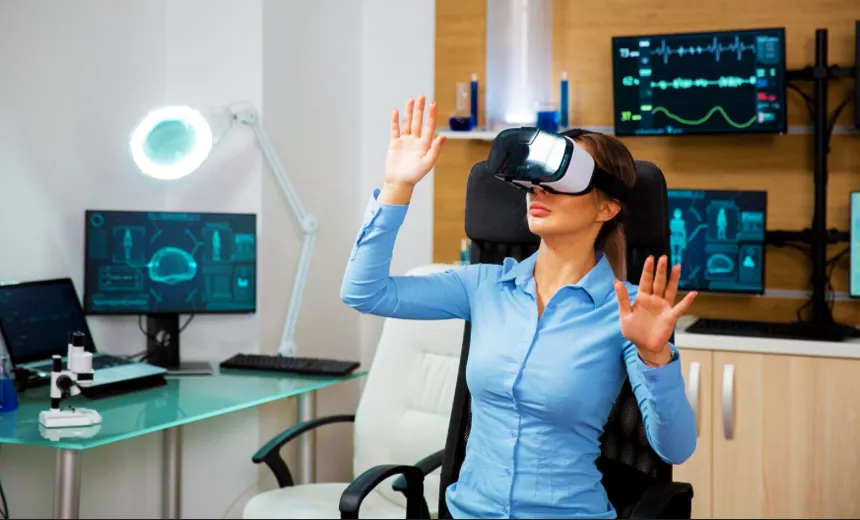
Enterprise Virtual Experiment & Simulation System Services
With the rapid development of AI, robotics, and digital education technologies, virtual experiment and simulation platforms have become essential tools for modern STEM and AI education. Enterprises can support schools and training institutions by providing advanced Virtual Experiment & Simulation Systems, enabling safe, efficient, scalable, and cost-effective learning environments.
The system is composed of three core modules: the Robotics Simulation Platform, the AI Vision Simulation Environment, and the Virtualised Laboratory. Each module can be deployed independently or integrated into a complete virtual simulation ecosystem.
1. Robotics Simulation Platform
Enterprises can offer a professional-level Robotics Simulation Platform that supports a wide range of robot-related courses, engineering practice, and competition training—without requiring any physical hardware.
Enterprise Service Offerings
1. Virtual Robot Modelling & Simulation Environment
Supports mobile robots, robotic arms, drones, and more
Includes physics-based simulation (dynamics, collision detection, friction modelling)
Multiple customizable scenes: factories, warehouses, campus roads, competition arenas, etc.
2. Robot Programming & Task Simulation
Supports Python, C++, Blockly, and other programming interfaces
Includes path planning, motion control, obstacle avoidance, grasping, line-following, and more
Learners can upload their own code and run real-time simulations with performance feedback
3. Curriculum Integration & Teaching Support
Ready-to-use course packages: robotics fundamentals, control systems, ROS basics, etc.
Instructor dashboard for assignment management, experiment monitoring, and performance tracking
Includes training modules for popular competitions (VEX, FLL, RoboCup)
Key Benefits
Build a risk-free, scalable virtual robotics learning environment
Reduce hardware procurement and maintenance costs
Provide students with hands-on engineering experience similar to real-world scenarios
2. AI Vision Simulation Environment
Enterprises can deliver an AI Vision Simulation Environment designed for image recognition, object detection, intelligent surveillance, and other computer vision courses. Students can perform full AI vision experiments without requiring real cameras or field data.
Enterprise Service Offerings
1. Multi-Scenario Vision Simulation System
Simulates common AI vision environments: traffic, retail, production lines, campus roads, etc.
Supports lighting changes, occlusions, motion disturbances, noise, and other realistic conditions
Virtual cameras with adjustable angles, field of view, and focal length
2. AI Vision Algorithm Training & Testing
Visual training interface for classification, detection, segmentation, and tracking models
Upload custom models and datasets; configure and manage training parameters
Auto-generated performance reports (accuracy, recall, F1 score, etc.)
3. Teaching Materials & Case Library
Includes real industry cases: traffic monitoring, facial recognition, warehouse automation
Instructors can design class projects, experiments, and homework assignments
Graphical visualisation to help students understand model behavior and algorithms
Key Benefits
Eliminates the need for expensive data collection and live video recording
Allows students to practice high-risk or hard-to-access scenarios safely (e.g., autonomous driving)
Supports interdisciplinary learning across AI, robotics, and automation
3. Virtualised Laboratory (Virtual Labs)
Enterprises can deploy cloud-based Virtual Labs, supporting AI, electronics, automation, and data science experiments—enabling remote, flexible, and shared educational experiences.
Enterprise Service Offerings
1. Cloud-Based Laboratory Management System
Browser-based access; no local installation required
Supports simultaneous multi-user access
Includes course management, experiment assignment, data tracking, and automated report generation
2. Multi-Disciplinary Virtual Experiment Modules
Enterprises can provide virtual labs in areas such as:
AI Labs: neural network training, model tuning, data analysis
Electronics Labs: circuit assembly, parameter tuning, waveform analysis
Automation Labs: sensor testing, PID control, system simulation
Data Science Labs: data cleaning, visualisation, statistical analysis
3. Learning Records & Assessment System
Automatically records experiment steps and user interactions
Generates experiment logs, reports, and evaluations
Instructors can view learning trajectories and operation histories
Key Benefits
Enable multi-discipline experiments without physical lab facilities
Significantly reduce equipment procurement and maintenance costs
Ideal for blended learning, remote education, and cross-campus resource sharing
Overall Value: Why Choose Enterprise Virtual Simulation Systems
The virtual experiment and simulation solutions provided by enterprises help educational institutions:
Reduce hardware investment by 50–80%
Prevent safety risks and equipment damage during experiments
Offer flexible “anytime, anywhere” learning
Support multi-disciplinary integration (AI + Robotics + Automation + Data Science)
Enhance institutional competitiveness and technology education capabilities
Enterprises can also deliver teacher training, courseware development, technical support, and full laboratory ecosystem construction, creating a comprehensive one-stop solution.